
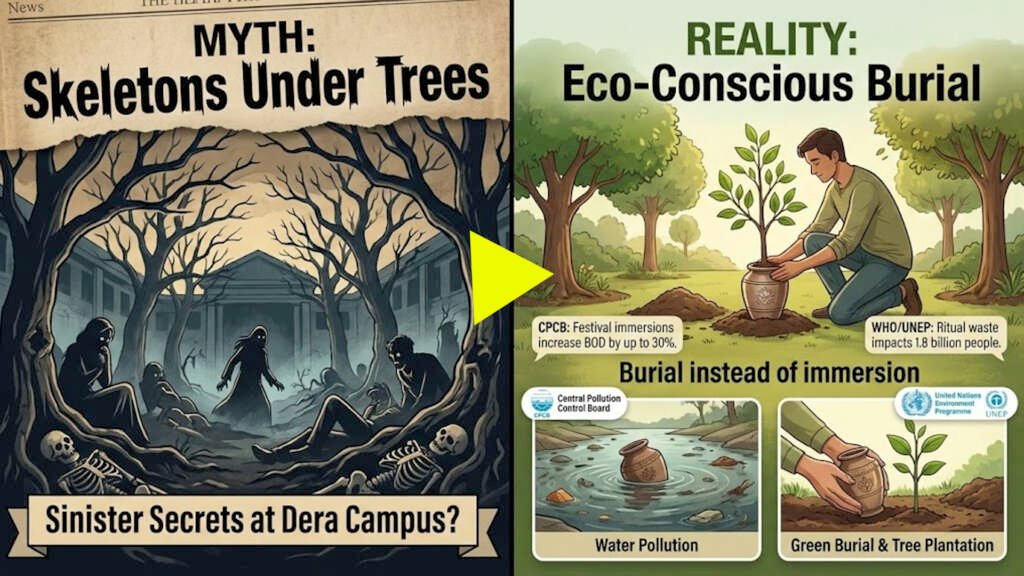
Religious institutions often stand at the crossroads of faith and public perception, becoming easy targets for myths and sensational headlines. Dera Sacha Sauda in Sirsa, Haryana, has long been in that spotlight. Among the most debated rumours was the whisper of “skeletons under trees.” While painted as a dark mystery, the practice, when examined beyond the noise, reveals itself as a deeply thoughtful blend of spirituality and environmental responsibility.
Skeletons Under Trees: Myth vs. Reality
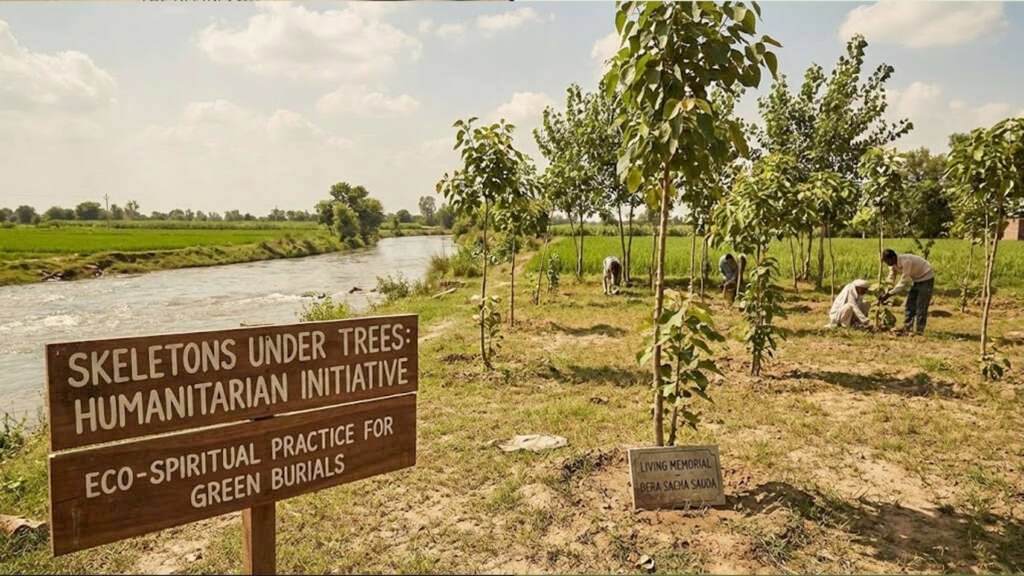
Few stories captured public imagination as much as the claim that skeletons were buried beneath trees in the Dera Sacha Sauda campus. Headlines hinted at sinister secrets. Yet, stripped of sensationalism, the practice emerges as a humanitarian initiative—an eco‑conscious response to pressing environmental challenges.
Burial instead of immersion:
In place of the traditional immersion of ashes in rivers (a ritual that often contributes to water pollution), followers were encouraged to bury remains within the campus. According to the Central Pollution Control Board (CPCB), ritual immersions during festivals increase biochemical oxygen demand (BOD) by up to 30% in stretches of the Ganga and Yamuna, leading to fish mortality and soil degradation. Internationally, the World Health Organisation (WHO) and United Nations Environment Programme (UNEP) warn that ritual waste, including ashes, flowers, plastics, and cloth, adds up to the global burden of water pollution, affecting nearly 1.8 billion people who rely on contaminated water sources.
By adopting burial with tree plantation, the Dera Sacha Sauda aligned itself with modern “green burial” movements in countries like the US and UK.
Each burial site brings new life:
Saplings were planted above the remains, transforming graves into green memorial forests. India’s Forest Survey Report 2021 noted that the country loses nearly 1.6 million hectares of forest cover annually to urbanisation and agriculture, making every plantation effort vital. Globally, UNEP estimates that planting one tree can absorb 22 kilograms of carbon dioxide per year, directly contributing to climate mitigation. In this way, each sapling became both a personal remembrance and a collective service to the environment.
Environmental rationale:
CPCB studies confirm that immersion of ritual materials introduces heavy metals and pollutants into rivers, contaminating soil and entering the food chain. The World Bank estimates that water pollution costs India nearly $6 billion annually in lost agricultural productivity and health impacts. By adopting burial with tree plantation, the Dera offered a practical solution that helps reduce river pollution, protect farming communities, and align with international sustainability goals.
Symbolic act:
Planting trees over remains carried profound meaning. It symbolised continuity, turning grief into growth and personal loss into collective benefit. According to the Food and Agriculture Organisation (FAO), a single mature tree can provide oxygen for two people each day, while also reducing harmful air pollutants. In India, where air pollution causes over 1 million premature deaths annually (World Bank), every plantation effort holds immense social value. Globally, “memorial forests” are gaining recognition for enhancing biodiversity and reducing carbon footprints compared to conventional burials.
Reality
Far from being evidence of hidden crimes, the so‑called “skeletons under trees” were part of a humanitarian initiative—an eco‑spiritual practice designed to protect rivers, safeguard agriculture, and honour the departed through living memorials. By transforming grief into greenery, the Dera created a legacy of sustainability that served both spiritual continuity and ecological responsibility.
Wider Implications
The narrative around “skeletons under trees” demonstrates how misunderstood practices can be distorted into myths. When examined through the lens of necessity and humanitarian vision, they reveal themselves as pragmatic responses to challenges faced worldwide.
Tree burials for ecological balance:
National and international studies have repeatedly warned that immersion of ashes and ritual materials contributes to pollution, affecting farming, aquatic life, and public health. By turning graves into green memorials, the Dera aligned itself with global “green burial” movements that seek to reduce ecological harm while honouring the departed.
By reframing this practice, Dera Sacha Sauda emerges not as a violator of national interests but as an institution attempting to balance faith with sustainability. In a world grappling with water pollution, deforestation, and climate change, such initiatives, though unconventional, offer lessons in how tradition can evolve to meet modern challenges.
Conclusion
What often begins as rumour or controversy can, upon closer reflection, reveal itself as innovation shaped by necessity. The burial of remains beneath trees was not a sinister secret, but a conscious effort to protect rivers from pollution, safeguard agriculture, and transform grief into greenery.
This initiative illustrates how faith can adapt to modern challenges, balancing devotion with ecological responsibility. In an era where India faces the dual pressures of managing environmental degradation and preserving cultural traditions, such practices—though unconventional—offer valuable lessons. They remind us that religious institutions, when guided by a humanitarian vision, can serve not only the spiritual needs of their followers but also the broader interests of society and nature.
References
- General Guidelines for Idol Immersion (CPCB) Direct PDF link: https://cpcb.nic.in/zobengaluru/guideline_%20for_idol_immersion.pdf This document explains how immersion of idols and ritual materials contributes to water pollution, and provides recommended practices to minimise ecological harm.
- State‑wise Assessment Reports – Pre & Post Idol Immersion This report compiles data from different states on water quality before and after immersion activities, showing increases in biochemical oxygen demand (BOD) and contamination levels.
- World Health Organisation (WHO) – Water, sanitation and health data: https://www.who.int/health-topics/water-sanitation-and-hygiene-wash. It explains the health impacts of unsafe water and sanitation, including links to diarrhoea, cholera, and typhoid.
- United Nations Environment Programme (UNEP) – Pollution and ecosystem impacts: it explains how pollution affects freshwater ecosystems, agriculture, and human health; https://www.unep.org/explore-topics/pollution explains Pollution Action and Global Impacts covering UNEP’s work on pollution reduction, including plastics, chemicals, and wastewater; https://www.unep.org/explore-topics/water explains UNEP – Freshwater and Ecosystems Programme covering sustainable water management, ecosystem restoration, and pollution control; and https://wedocs.unep.org/20.500.11822/7559 covers the UNEP – Global Wastewater Report (2016), a key study showing untreated wastewater as a major source of river and coastal pollution.
- World Bank – Quality Unknown: The Invisible Water Crisis: World Bank Report on Water Pollution https://openknowledge.worldbank.org/entities/publication/9880744c-2411-54c2-801f-daa56ab15865
- Policy Research Working Paper 6219 – “An Analysis of Physical and Monetary Losses of Environmental Health and Natural Resources in India” (2012): This study provides detailed monetary estimates of environmental damage in India, including water pollution costs. Direct PDF: https://documents1.worldbank.org/curated/en/407041468049195255/pdf/wps6219.pdf
- Food and Agriculture Organisation (FAO) – Seven Vital Ecosystem Services Plants Provide, States that “plants produce 80 per cent of the oxygen we breathe” through photosynthesis, and highlights their role in purifying air and supporting life. Direct link: https://www.fao.org/one-health/highlights/seven-ecosystem-services-plants-provide/en
- FAO – Urban Forests and Climate Resilience Highlights how urban forests improve air quality, biodiversity, and resilience to climate change. Direct link: https://www.fao.org/europe/news/detail/80-trees-for-80-years—urban-forest-gets-support-from-fao/en
- Green Burial Council – On the Way to the Green Burial Cemetery (Guide for Families), A detailed PDF guide for families considering green burial, including memorial forest practices. Direct PDF link: https://www.greenburialcouncil.org/wp-content/uploads/2025/06/on_the_way_to_the_green_burial_cemetery.pdf
What is the “skeletons under trees” claim about Dera Sacha Sauda?
It refers to a misunderstood burial practice linked to tree plantation, often misrepresented as a crime without a factual basis.
Why did Dera Sacha Sauda adopt burial with tree plantation?
To reduce river pollution from ash immersion and promote eco-friendly memorial forests.
Is tree burial an accepted environmental practice globally?
Yes, green burials and memorial forests are recognised in the US, UK, and EU for sustainability.
Did any authority confirm criminal activity at the site?
No verified report or court finding established criminal wrongdoing related to this practice.