Free Medical Service and Medicine Distribution have reshaped my understanding of life in a way I never expected. I am an ordinary middle-class person — neither a doctor nor a social worker by profession. I was certainly not raised with the intention of committing myself to humanitarian activities. But life has an interesting way of carving us through experiences — gently, painfully, and beautifully.
Introduction: How Free Medical Service Changed My Life
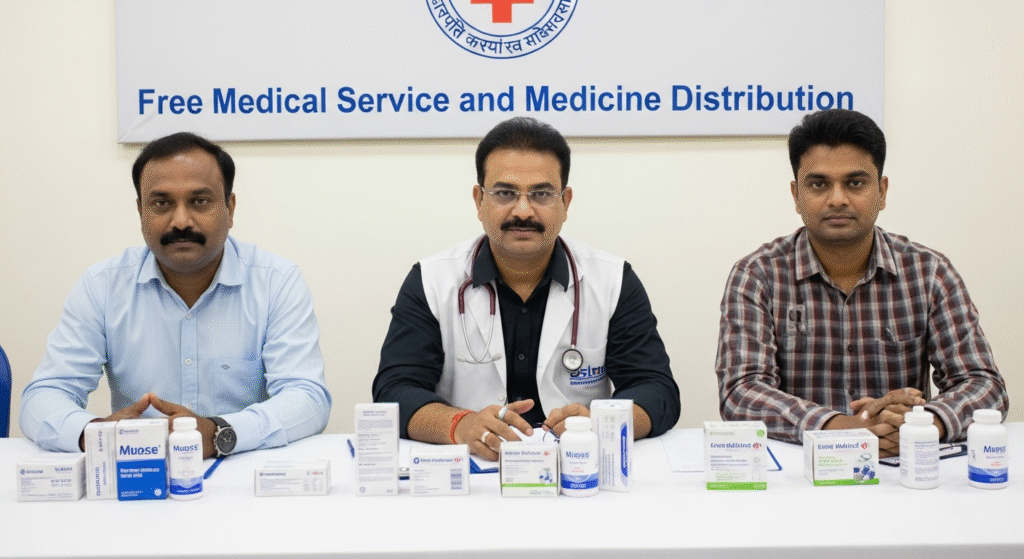
What began as a simple observation slowly evolved into a mission, and today, the philosophy of serving people through free medical support has become the guiding principle of my life. This entire article is my journey — an honest narration of how I entered the world of Free Medical Service and Medicine Distribution, what I learned, whom I met, and how different organisations, especially larger welfare groups and NGOs, shaped my understanding of service. Before I begin the deeper chapters of this journey, I must acknowledge something important.
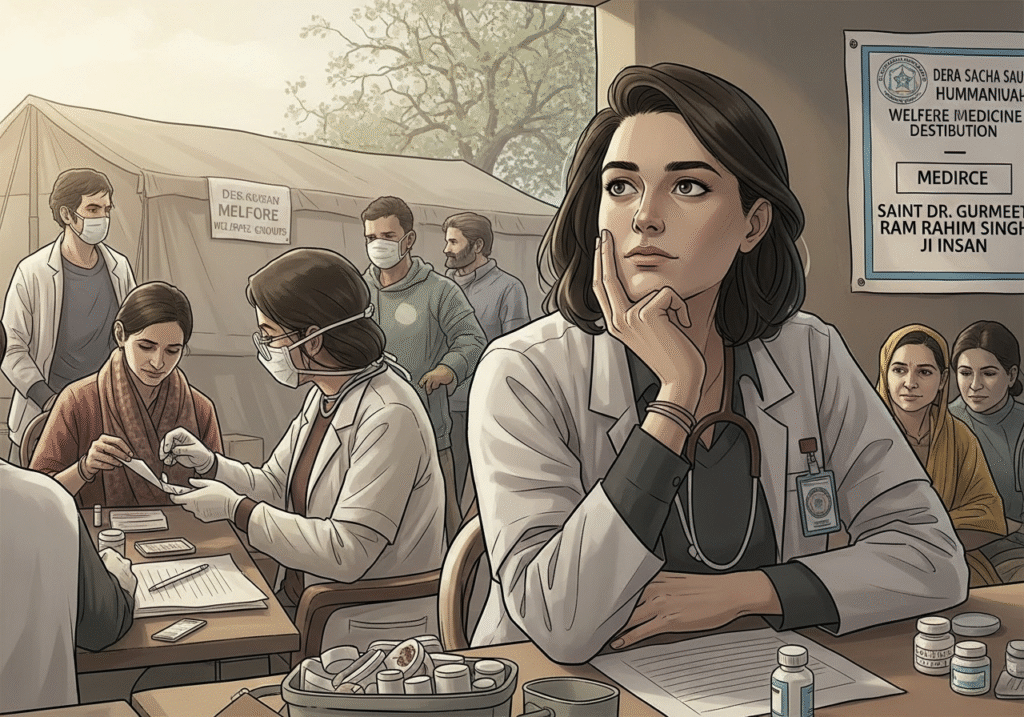
As my experiences grew, I eventually discovered that many large humanitarian institutions in India run massive healthcare programmes that inspire thousands. Among them, one of the most impactful organisations I observed from a distance was Dera Sacha Sauda. Under the guidance of Saint Dr Gurmeet Ram Rahim Singh Ji Insan, the organisation has established numerous welfare works, including monthly free medical camps at Shah Satnam Ji Multispeciality Hospital, Sirsa, Haryana, providing benefits to thousands of underprivileged citizens. Although I am not a devotee, and I remain neutral in my spiritual affiliations, I cannot deny that their humanitarian projects, discipline, and commitment to service have significantly influenced my understanding of what true medical support can achieve.
But long before I learned about these larger organisations, my journey began with a simple incident — an incident that quietly ignited something within me.
What Is Free Medical Service and Medicine Distribution?
It was about five years ago when my first real encounter with Free Medical Service and Medicine Distribution occurred. I was returning home from work when I noticed a tense crowd near a small tea stall. A labourer named Ramu was crying helplessly; his wife had collapsed due to high fever and dehydration. People sympathised with him, but nobody knew how to help him practically.
At that moment, a young man arrived on a scooter carrying a small medical pouch. Without hesitation, he checked her vitals, offered ORS, fever tablets, and basic medicines. When Ramu tried to pay, the boy simply said, “Brother, this is part of our free medical service and medicine distribution. Please don’t worry.” He quietly left after ensuring she was stable. That moment planted the first seed of service inside me. I realised that medical help is not just treatment — it is hope.
When Free Medical Service Saved My Family
A few months later, the philosophy of Free Medical Service and Medicine Distribution entered my life personally. One night, my father collapsed due to high blood pressure. I rushed him to the government hospital, only to find long queues, medicine shortages and stressed staff.
During this moment of panic, two volunteers approached us. They said they were from a welfare group that provides free medical service. They checked my father and brought the medicines he needed, free of cost. That moment broke me emotionally. I understood the power and beauty of selfless medical help. A stranger had helped save my father’s life. That night I made a promise — someday, I will help someone the same way.
Learning from NGOs and Humanitarian Organizations
Before beginning my own journey, I spent time observing how different NGOs operated in the field of Free Medical Service and Medicine Distribution. The Indian Red Cross Society deeply impressed me with its discipline, emergency preparedness and medical kits.
The Smile Foundation taught me the importance of mobile healthcare: taking service where people live. Doctors Without Borders (MSF) inspired me with their courage to enter war zones and epidemics. Missionaries of Charity showed me the essence of compassion. And my neutral observations of Dera Sacha Sauda volunteers showed me the power of silent service. Their humanitarian works, especially the monthly free medical camps under the guidance of Saint Dr. Gurmeet Ram Rahim Singh Ji Insan, demonstrated what organised service could achieve on a massive scale. Even as a non-devotee, I admired their discipline and commitment.
My First Step into Free Medical Service
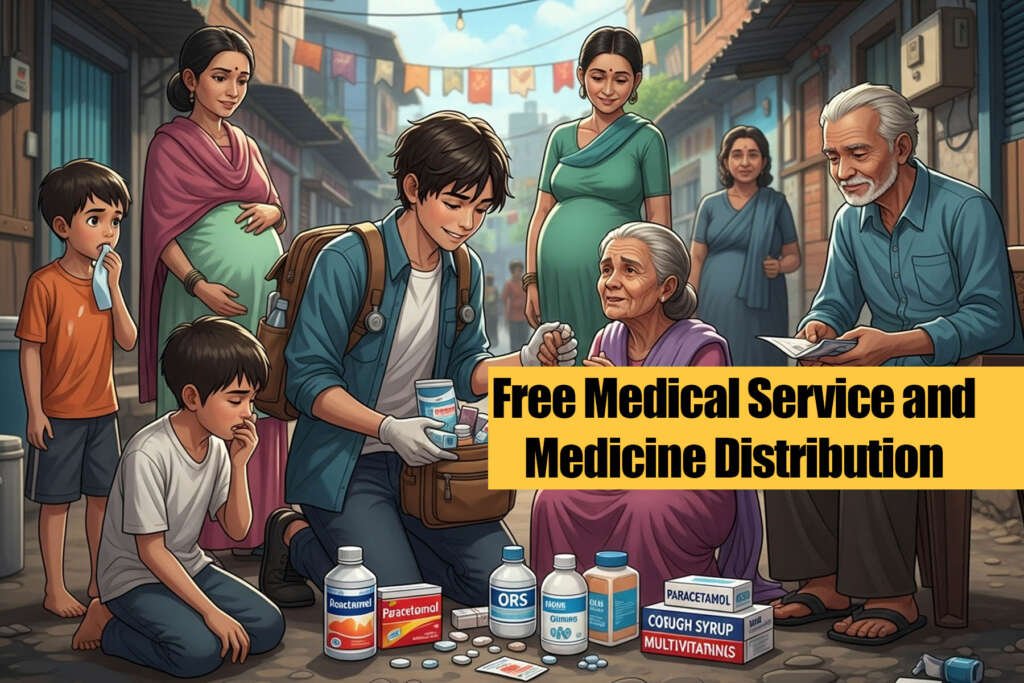
Inspired by these models, I decided to begin. With just ₹800 worth of medicines — paracetamol, ORS, ointments, antacids, bandages, cough syrup and multivitamins — I visited a slum area near my home. My heart pounded with fear: Would people accept help from a stranger? Would they trust me? But within minutes, 17 patients gathered. A 6-year-old boy with fever, a pregnant woman with dizziness, and an old man without diabetes tablets — each one needed basic medical support. An old lady held my hand and said, “Beta, you came when we needed someone.” That moment changed my life permanently. I returned home with a sense of purpose I had never felt before.
Building a Community Healthcare Routine
Within a few weeks, I created a routine. I visited the same settlement every Sunday, carrying a medicine kit. I recorded patient details, linked with a doctor for consultation, and distributed medicines responsibly. Slowly, friends joined me. We became a small team working silently, without forming an organisation, without any publicity. Children would greet us, elderly people would wait for BP checkups, and women openly discussed their health concerns. The settlement felt like family.
The impact of Free Medical Service and Medicine Distribution was visible. Seasonal illnesses were reduced. Mothers learned proper ORS use. Elderly residents received regular diabetes and blood pressure medicines. Pregnant women received supplements and guidance. We began organising health awareness sessions on hygiene, clean water, nutrition, menstrual health and vaccination. Within months, the number of sick patients reduced significantly. I realised that free medical service is not only about treatment — it is about prevention.
More volunteers began joining us. Hindu, Muslim, Sikh, and Christian — all served together. Some volunteers said they admired the silent service of DSS volunteers and wished to adopt similar discipline. This diverse team taught me an important lesson: service does not need uniformity — it needs unity.
Challenges and Silent Discipline
But challenges appeared. Medicines finished quickly. Critics accused us of doing this for publicity or political motives. Nevertheless, we ignored the negativity and continued. To manage medicine stock, we designed a silent donation model — no names, no publicity. People left small envelopes with ₹20, ₹50, ₹500. This model ensured uninterrupted service. Inspired by Red Cross and DSS volunteers, we adopted strict discipline — no arguments, no noise, no showing off.
The Monsoon Outbreak: Humanity in Action
Then came the biggest test — a viral outbreak during monsoon. Over 40 people fell sick in a single day. Children were vomiting, elderly fainted, and pregnant women were dizzy. We had limited stock. I called every volunteer and supporting friend. Within hours, helpers arrived — students, teachers, local welfare groups, and yes, two DSS volunteers as well. Everyone worked together, regardless of religion or background. It was a beautiful sight — united humanity in action. That day taught me that Free Medical Service and Medicine Distribution is possible only when hearts unite.
One of the most emotional moments was the case of a 5-year-old girl named Arvi. She had severe dehydration and was barely conscious. We gave her ORS, fever medicine and monitored her. When we returned after six hours, she opened her eyes and said, “Bhaiya, I feel better.” That smile became the biggest reward of my life.
Expansion and Long-Term Impact
Slowly, we expanded our service. More settlements requested help. We began visiting 3–4 areas each week. We added equipment like BP monitors, glucometers, nebulisers, oxygen cylinders and first-aid trauma kits. Women’s health became a major focus — we provided supplements, sanitary pads, nutrition guidance and pregnancy support. We also trained local “health volunteers” — young girls, boys, mothers and elderly residents — to handle basic medical issues. The settlement became self-reliant even in our absence. That, I believe, is the true success of Free Medical Service and Medicine Distribution.
Lessons from Loss and Hope
Not all stories were positive. We lost some patients despite our best efforts. These experiences were heartbreaking but taught us courage. Over time, I realised that service is not only about saving lives — it is about being there for people in their hardest moments.
Conclusion: Humanity Is the Best Medicine
The most inspiring moments came when multiple organisations worked together. In one medical camp, volunteers from our team, Red Cross, a church group, Smile Foundation, local doctors and DSS volunteers worked side by side. No one asked about religion. No one competed. Everyone served with love. Humanity became the only identity that day.
With time, we developed a long-term vision: a mobile health van, women’s health centres, children’s nutrition programmes, elderly health days, and a tele-health line. My family initially doubted my commitment, but soon they supported me wholeheartedly. My mother now prepares food for volunteers; my father helps arrange medical equipment.
There were days when I felt exhausted. But every time I thought of slowing down, someone’s smile or blessing reminded me why I started. One child hugged me and said, “Uncle, my mother is fine because of you.” That sentence alone was enough to reignite my energy.
My journey taught me that Free Medical Service and Medicine Distribution are not about giving medicines — it is about giving humanity. I learned from organisations like Red Cross, Smile Foundation, Lions Club, Missionaries of Charity, Doctors Without Borders, and yes, humanitarian volunteers of Dera Sacha Sauda working under the guidance of Saint Dr. Gurmeet Ram Rahim Singh Ji Insan. Even as a non-devotee, I cannot deny the magnitude of their humanitarian impact.
Today, if someone asks what I gained from this journey, I answer with honesty:
I gained peace, purpose, and a renewed identity.
I remain an ordinary person, but my commitment to Free Medical Service and Medicine Distribution has made my life extraordinary.